- Sections :
- More


One of the things I like best about our current exhibition, SPECTACLE, is how it opens doors to the wider world. It has been fascinating to hear visitors discuss these photographs that showcase scenes from across the globe.
One image that has sparked frequent conversation is a photograph of Michelangelo’s David. Taken from an unusual angle, photographer Paolo Woods captures the sculpture from over David’s left shoulder, looking down onto a group of admiring spectators. This perspective highlights David holding his sling, his face in profile and set in deep concentration before his battle with Goliath. The vantage point also emphasizes the sculpture’s remarkable scale. Many visitors know that David stands approximately 17 feet tall, but seeing it from this angle truly conveys how dramatically it towers over viewers. Widely regarded as a masterpiece of Renaissance sculpture, Michelangelo completed David in his mid-to-late twenties—an astonishing achievement for such a young artist. The photograph is truly striking.
Another image drawing significant attention is Fei Yang’s photograph of Larung Gar, located in the Garzê (Ganzi) Tibetan Autonomous Prefecture in China. Often described as one of the largest centers of Tibetan Buddhism in the world, Larung Gar appears as a vast sea of red, with countless small wooden dwellings cascading across the mountainside. While some have referred to it as the “highest slum in the world,” those who live there—monks, nuns, and students—come in pursuit of spiritual study and devotion rather than material comfort. Seeing this image here in Western Kansas, surrounded by wide open plains, can create a sense of cultural contrast for many visitors. Several have remarked on how difficult it must be to distinguish one home from another among the dense clusters of red structures. Although the exact date of Fei Yang’s photograph is unknown, research indicates that in recent years Chinese authorities have imposed restrictions and carried out partial demolitions within the settlement.
A photograph by Dave Yoder of Pope Francis captures a quiet moment in the Sistine Chapel following his “Urbi et Orbi” address on Christmas Day. Unlike many images of the chapel, which focus on Michelangelo’s famous ceiling frescoes, Yoder’s photograph centers on the Pope standing near the transenna—a marble screen separating the clergy from the laity. This perspective reveals the chapel’s elongated proportions, offering a view that differs from the more commonly seen upward-facing images of the ceiling. Visitors have also noted the beauty of the chapel’s intricate mosaic floor. One observer pointed out that the proportions and design of the Sistine Chapel were inspired in part by descriptions of Solomon’s Temple, a connection subtly reinforced through this unique vantage point.
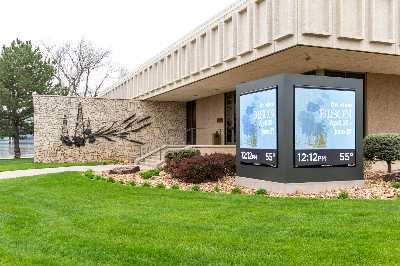
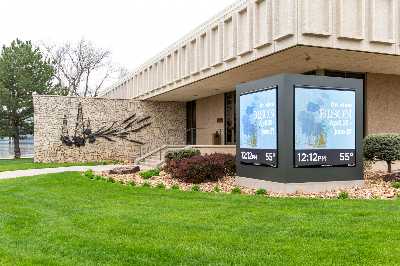
The Hansen Museum invites you to visit SPECTACLE, an exhibition that offers a rich and engaging experience for visitors of all ages. The Museum is located at 110 W. Main Street in Logan, Kansas. Hours are Monday–Friday, 9:00 a.m.–12:00 p.m. and 1:00–4:00 p.m.; Saturday, 9:00 a.m.–12:00 p.m. and 1:00–5:00 p.m.; and Sunday and holidays, 1:00–5:00 p.m. The Museum is handicap-accessible, and thanks to the Dane G. Hansen Foundation, admission is always free. For more information, please call 785-689-4846. We hope to see you at the Museum soon!